Settlement does not announce itself. It shows up as a door that needs a shoulder, a hairline crack above a window frame, a marble that will not sit still on the kitchen floor. Individually these read as an old building being an old building. Together they are a structure moving.
This post covers how to tell settlement from the other thing it gets confused with, why the common repairs fail, and what underpinning with helical piers actually does. It is written for the person deciding whether to call someone, and for the repair contractor deciding what to install.
01What are the warning signs of foundation settlement?
Settlement produces a recognizable set of symptoms because a sinking foundation distorts the frame above it in predictable ways.
- ◆Stair step cracks running diagonally through brick, block, or stone, following the mortar joints
- ◆Doors and windows that stick or will not latch, because the openings are no longer square
- ◆Sloping or uneven floors, often noticeable at a doorway threshold or with a level laid across a room
- ◆Gaps between walls and ceilings, or crown molding pulling away at a corner
- ◆A chimney tilting or separating from the wall it sits against
- ◆Cracks that widen over time, which is the single clearest indicator that movement is still active
Cracks wider than one eighth of an inch, or visible changes in floor elevation, warrant a structural assessment rather than a wait and see approach. Not because every crack means crisis, but because active movement gets more expensive with every month it continues.
02Is it settlement, or is it heave?
This is the distinction that decides the entire repair, and it is the one most often gotten wrong.
Settlement is downward movement. Soil beneath the foundation compresses, washes out, or consolidates, and the structure follows it down. It produces stair step cracking, sloping floors, and sinking corners.
Heave is upward movement. Expansive clay soils take on moisture and swell, pushing the foundation up. It produces horizontal cracking, buckled or domed floors, and slab cracks that intersect in a spidered pattern.
They look similar from across the room. They are opposites, and the repairs are opposites. Underpinning is designed to correct settlement. Installing piers on a structure that is heaving can lock it into an elevated position and make the damage permanent. Heave is addressed through moisture management, drainage correction, and soil stabilization.
Any contractor who quotes piers before anyone has established which direction the structure is moving is guessing with your building.
03What causes a foundation to settle?
Uniform settlement, where a structure moves down evenly, is normal and mostly harmless. Granular soils may give up a quarter inch, clay soils an inch or two, over the first several years. Nothing distorts because everything moves together.
Differential settlement is the problem. One part of the foundation moves and another does not, and the structure has to absorb the difference. The usual causes:
- ◆Water. Poor drainage, downspouts discharging at the foundation, a plumbing leak under a slab, a fluctuating water table, or erosion after heavy rain. Water washes out the fine particles that give soil its bearing capacity.
- ◆Poorly compacted fill. Construction over fill that was never properly compacted, which then consolidates under load for years afterward.
- ◆Soil variation across the site. Competent soil under one half of the footprint and soft or organic material under the other.
- ◆Drought and vegetation. Clay soils shrink as they dry. Large trees close to a foundation pull moisture out of the soil on one side and not the other.
- ◆Loads the original foundation never anticipated. An addition, a second story, or heavy equipment added decades after the footing was designed.
04Why do surface repairs fail?
Because they treat the drywall and leave the soil alone.
Crack injection and patching restores appearance. If movement is still active, the crack returns, usually within a season or two.
Mudjacking and polyurethane injection pump material beneath a settled slab to raise it. This is genuinely useful for a sunken driveway, sidewalk, or garage slab. It does not work for a structural foundation, because it lifts against the same soil that already failed to carry the load.
Shimming and cosmetic leveling hides the slope. The structure keeps moving underneath it.
None of these are scams. They are simply solutions to a different problem. If the soil under the footing cannot carry the structure, the only durable answer is to stop asking it to.
05How does underpinning with helical piers stop settlement?
Underpinning transfers the structure's load off the failing soil and onto soil that will carry it.
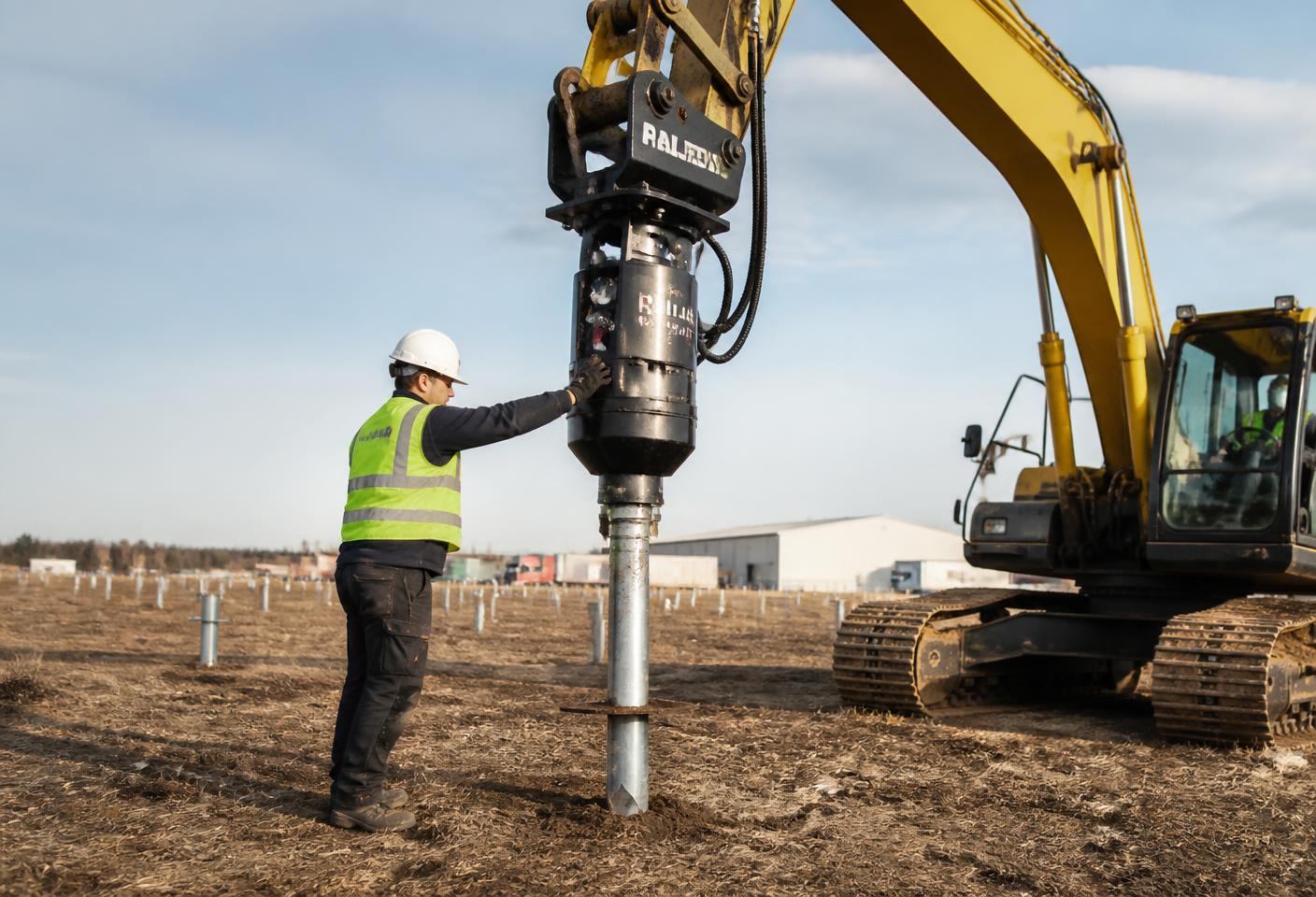
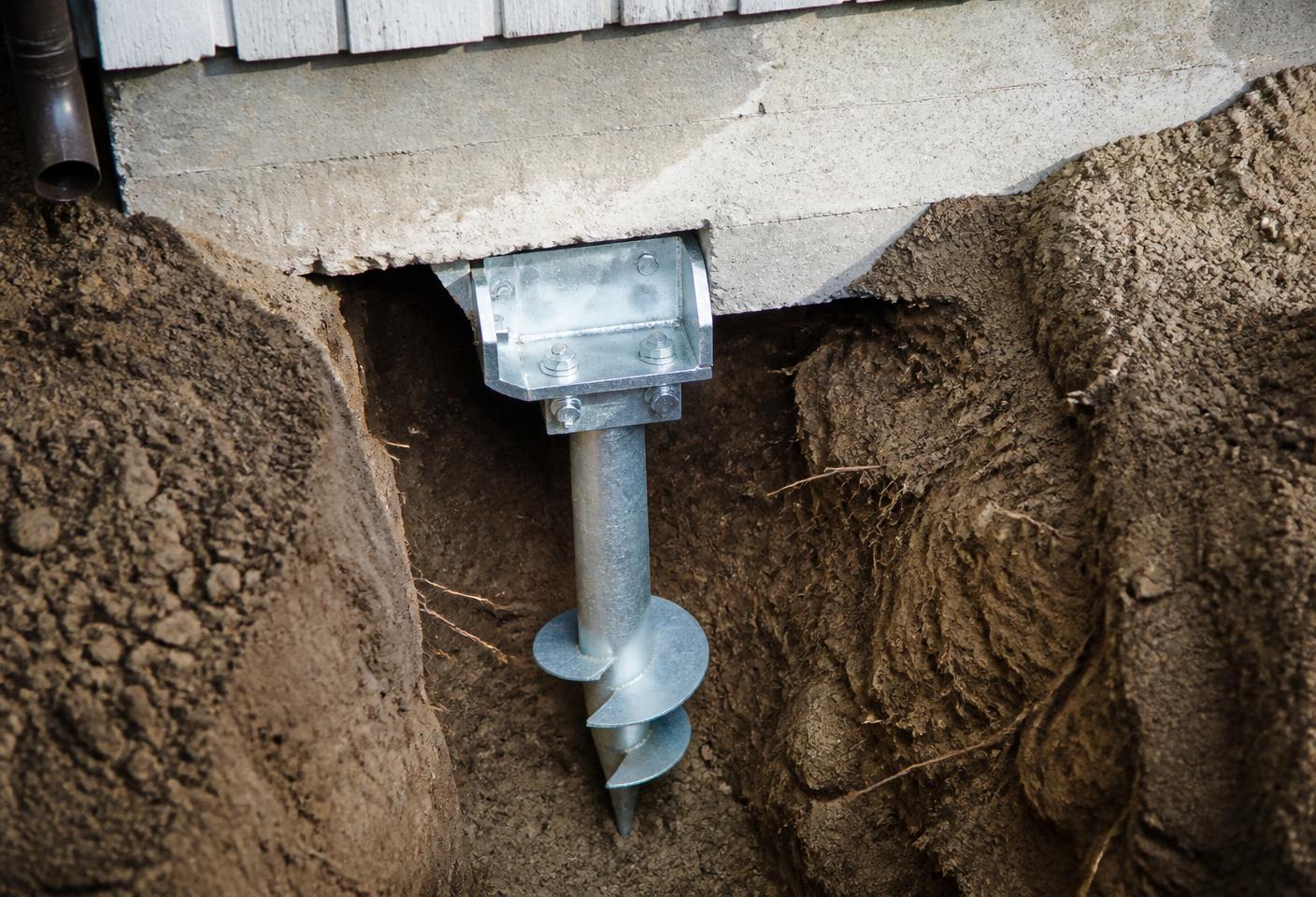
A helical pier is a steel shaft with one or more helix plates near the tip. A hydraulic drive head rotates it into the ground, and the helix plates pull it down through the weak material until they reach a bearing stratum with the strength the design requires. A retrofit underpinning bracket then connects the pier to the existing footing, and the load path moves from the old soil to the new pier.
Four things make this the method of choice on repair work:
Capacity is verified as each pier installs. Installation torque correlates directly to load capacity through the manufacturer's torque correlation factor. A pier finishing at 5,000 foot pounds with a factor of 10 indicates roughly 50,000 pounds of ultimate capacity. Every pier gets documented. Nobody is assuming.
It does not require bedrock. The helix plates develop bearing in competent soil, so the system works where bedrock is hundreds of feet down or absent.
The equipment fits. Interior basement work, tight side yards, and low overhead clearance are routine. Compact hydraulic drive heads reach places a driven pile rig will never go.
Load transfers immediately. No cure time, no waiting. Piers can be installed and the structure stabilized while it stays occupied, and most stabilization work takes a few days rather than weeks.
Our underpinning products and retrofit brackets are built for this work specifically, and the foundation repair application page covers the configurations we supply most often.
06Can helical piers lift a structure back to level?
Often, yes, and this is where judgment matters more than equipment.
Once piers are installed and bearing, crews can apply coordinated hydraulic pressure across all of them to bring the structure back toward its original elevation. Doors start latching again. Cracks close. It is a real and satisfying result.
It is also not always the right goal. A structure that has sat in a settled position for thirty years has accommodated that position: plumbing has been rerouted, tile has been set, framing has taken a set. Aggressive lift can open new damage in the process of closing old damage. Experienced repair contractors often stabilize fully and lift partially, recovering most of the elevation and leaving the rest alone.
Stabilization is the engineering requirement. Lift is the bonus. A contractor who promises full recovery before seeing the structure is selling, not assessing.
07What should a repair contractor demand from the pier?
On repair work, the pier carries the entire structure through a single eccentric bracket connection, and the coupling between shaft sections is the highest stress point in the system. That connection is where cheap piers fail.
Every Helical Anchors shaft is joined with patented inertia welding, a friction welding process that forges a full cross section bond through the joint rather than laying a bead around the outside of it. That is the difference between a coupling that matches shaft strength and one that becomes the weak link exactly where the load concentrates.
Our systems are listed under ICC-ES ESR-3982, so inspectors approve them without a project specific evaluation, and the full capacity data, bracket ratings, and torque correlation factors are published in our technical library.
Settlement is a soil problem wearing a drywall costume. Repairs that treat the drywall are why so many structures get fixed twice.
If you are a repair contractor specifying underpinning, or a design professional working through capacity on an existing structure, our engineering team will work the numbers with you. Request a quote and bring the soil data.
Frequently Asked Questions
Stair step cracks in masonry, doors and windows that begin to stick, sloping floors, gaps between walls and ceilings, and a chimney pulling away from the structure. Cracks that widen over time indicate the movement is still active.
Underpinning extends structural support down to competent soil below a failing foundation. Steel piers are installed beneath or alongside the existing footing and connected with brackets, transferring the structure's load past the soil that can no longer carry it.
Yes, when settlement is the actual problem. The piers bypass the failing soil entirely and bear on competent strata, so the load path no longer depends on the material that caused the movement. Verified installation torque confirms each pier's capacity as it goes in.
Frequently, yes. After the piers bear, coordinated hydraulic lift can recover much of the lost elevation. Full recovery is not always advisable on structures that have been settled for many years, since aggressive lift can create new damage.
They serve different conditions. Push piers use the structure's own weight to drive to bedrock or dense strata and suit heavy structures over deep competent material. Helical piers generate capacity through helix bearing without needing bedrock, install with verified torque, work in a wide range of soils, and handle lighter structures and tight access that push piers cannot.